How to Get Rid of Hair Algae in a High Tech Aquascape?
You spent weeks building your dream aquascape. The plants are in, the CO2 is running, and the lights are perfectly timed. Then one morning, you spot it. A thin green strand clinging to your favorite plant. Within days, that single strand turns into a fuzzy green blanket covering your hardscape, your carpet plants, and even your filter intake.
Hair algae is one of the most frustrating problems in a high tech planted tank. It grows fast. It looks terrible. And it can smother your plants if you ignore it. The worst part? Many aquascapers make the problem worse by guessing at solutions instead of identifying the root cause.
This guide will walk you through exactly what causes hair algae in a high tech setup and how to eliminate it for good. You will learn how to adjust your CO2, fine tune your lighting, balance your nutrients, and use biological allies to keep your tank clean.
Key Takeaways
- Hair algae thrives on imbalance. The most common triggers in a high tech tank are inconsistent CO2 levels, excessive light intensity or duration, and poor nutrient ratios. Fixing the imbalance is more effective than any quick chemical fix.
- CO2 consistency matters more than CO2 quantity. Fluctuating CO2 levels stress your plants and give algae an opening. Aim for a steady 20 to 30 mg/l throughout the lighting period and start injection 60 to 90 minutes before lights turn on.
- Manual removal is your first line of defense. Use a toothbrush, pipe cleaner, or your fingers to physically remove as much hair algae as possible during each water change. This reduces the algae’s ability to reproduce and spread.
- Algae eating crew members are essential. Amano shrimp, Siamese algae eaters, and certain snail species will graze on hair algae constantly. A proper cleanup crew can prevent minor outbreaks from becoming major infestations.
- Large weekly water changes reset the system. Changing 50% of your aquarium water each week removes excess organic waste, dilutes accumulated nutrients, and gives your plants a fresh start to outcompete the algae.
- Patience and consistency beat drastic measures. A blackout or hydrogen peroxide treatment can help in severe cases, but long term success depends on maintaining stable tank conditions day after day.
What Is Hair Algae and Why Does It Target High Tech Tanks
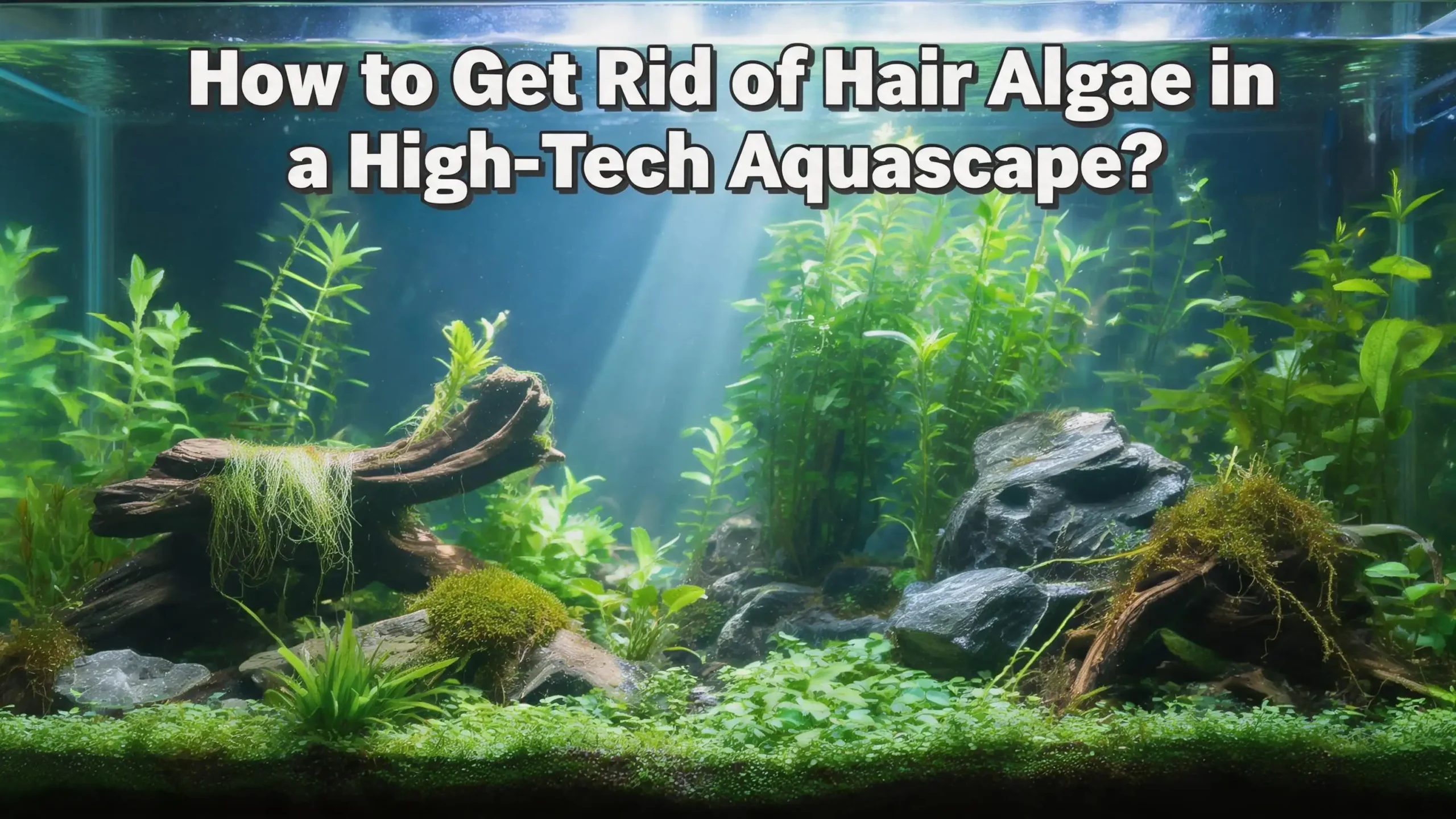
Hair algae refers to several species of filamentous green algae, most commonly from the genus Oedogonium. These algae grow in long, thin strands that look like green hair or thread. They attach to plant leaves, hardscape, substrate, and equipment.
High tech aquascapes are especially prone to hair algae because they combine three powerful growth factors: intense lighting, pressurized CO2 injection, and regular fertilizer dosing. When these three elements are perfectly balanced, plants grow fast and outcompete algae. But even a small imbalance gives hair algae the opening it needs.
The reason is simple. Hair algae adapts to environmental changes faster than aquatic plants do. When your CO2 drops unexpectedly or your light runs too long, your plants slow down while the algae speeds up. This is why hair algae often appears in tanks where the aquascaper recently changed one variable, like swapping a light fixture, adjusting a CO2 regulator, or switching fertilizer brands.
New high tech tanks are particularly vulnerable during the cycling phase. The biological filter is still maturing, ammonia spikes are common, and the plants have not yet established strong root systems. Algae spores are always present in aquarium water. They just wait for the right conditions to bloom.
Understanding this basic principle is the foundation for every solution in this guide. You do not fight hair algae by attacking the algae itself. You fight it by creating conditions where your plants win the competition for light and nutrients.
How to Identify Hair Algae in Your Aquascape
Before you start treating your tank, make sure you are actually dealing with hair algae and not a different type. Misidentification can lead you to apply the wrong solution. Hair algae has distinct characteristics that set it apart from other common aquarium algae.
Hair algae strands are long, soft, and green. They can range from half an inch to several inches in length. The strands often wave gently in the water current. When you touch them, they feel slippery and pull away from surfaces in clumps. You can twist a toothbrush into a patch of hair algae and the strands will wrap around the bristles easily.
This is different from black beard algae (BBA), which grows in short, dense tufts and has a dark gray or black color. It is also different from staghorn algae, which branches out like antlers and feels stiff. Green dust algae, another common type, forms a thin film on glass rather than growing in strands.
Hair algae typically appears first on slow growing plants, older leaves, and hardscape surfaces that receive direct light. If you notice green fuzz on your Anubias, Bucephalandra, or driftwood, that is likely the beginning of a hair algae outbreak. It may also appear on the tips of carpet plants like Monte Carlo or dwarf hairgrass.
Check your tank daily during the first few weeks of a new setup. Early detection makes removal far easier. A small patch caught on day two takes 30 seconds to remove. That same patch left for two weeks can spread across the entire tank.
How Unstable CO2 Levels Trigger Hair Algae Growth
CO2 is the single most important factor in preventing hair algae in a high tech aquascape. The problem is rarely about having too little or too much CO2. The problem is inconsistency. When CO2 levels swing up and down throughout the day, plants cannot maintain steady photosynthesis. This stress weakens them, and weakened plants release organic compounds from their leaves that actually encourage algae attachment.
The ideal CO2 concentration for a high tech planted tank is 20 to 30 mg/l, measured with a drop checker. The drop checker solution should show a consistent green color throughout the entire lighting period. If it turns blue at any point, your CO2 has dropped too low.
Several things can cause CO2 fluctuations. A poorly calibrated regulator may allow the bubble rate to drift. Surface agitation from a filter outlet can off gas CO2 faster than it dissolves. A diffuser placed in a low flow area may not distribute CO2 evenly across the tank.
Start your CO2 injection 60 to 90 minutes before lights turn on. This ensures the water is already saturated with CO2 when photosynthesis begins. If you wait until the lights come on to start CO2, your plants spend the first hour or two in a low CO2 environment, which gives algae an advantage.
Use an inline diffuser or place your ceramic diffuser directly in the path of your filter outflow. Good CO2 distribution means every corner of the tank receives the same concentration. Dead spots with low CO2 often become the first places where hair algae appears.
How Light Intensity and Duration Affect Hair Algae
Light is the energy source for both plants and algae. In a high tech aquascape, you need strong light to drive fast plant growth. But too much light or light that runs too long creates an excess of energy that your plants cannot use, and hair algae happily absorbs the surplus.
Most experienced aquascapers recommend limiting the lighting period to 6 to 8 hours per day in a high tech tank. Longer durations, especially beyond 10 hours, increase the risk of algae blooms significantly. If you are battling an active hair algae outbreak, drop your photoperiod to 6 hours immediately.
Light intensity matters just as much as duration. A brand new high output LED running at full power over a tank with young plants is a recipe for algae. Your plant mass needs to match your light output. In the first few weeks of a new aquascape, dim your lights to 50% to 60% intensity and gradually increase over the following months as your plants fill in.
Avoid placing your tank near windows. Even indirect sunlight can add extra light energy that throws off your carefully planned schedule. A brief period of direct sun from across the room can trigger a patch of hair algae in the spot it hits.
If your light does not have a dimmer function, raise the fixture higher above the water surface. Every inch of added distance reduces the light intensity reaching your plants and substrate. The goal is to match your light output to the amount of plant mass and CO2 available in your tank. When these three factors are balanced, algae loses the competition every time.
Why Nutrient Imbalance Feeds Hair Algae
A high tech aquascape requires regular fertilizer dosing to keep plants growing at their full potential. But nutrient imbalance is one of the most common causes of hair algae. This happens when one or more nutrients are either too high or too low relative to the others.
The key macronutrients for aquatic plants are nitrogen (N), phosphorus (P), and potassium (K). Recommended levels for a high tech tank are roughly 10 to 25 mg/l nitrate, 0.1 to 1 mg/l phosphate, and 5 to 10 mg/l potassium. When these ratios fall out of balance, plants cannot grow efficiently, and the unused nutrients become available for algae.
Excess iron is a particularly common trigger for hair algae. Many aquascapers overdose iron thinking it will improve red plant coloration. While iron is important, too much of it directly feeds filamentous green algae. Dose iron conservatively and test your levels regularly.
Nitrogen deficiency is another frequent cause. When nitrate drops to zero, plant growth stalls. Stalled plants mean less nutrient uptake overall, which causes a cascade of imbalances. If your plants show pale new growth or yellowing older leaves, test your nitrate levels immediately.
Avoid fertilizers that contain ammonia or urea as a nitrogen source. Ammonia is a powerful algae trigger, especially in tanks with high light. Use nitrate based fertilizers instead. A consistent dosing schedule paired with weekly water testing will reveal imbalances before they become visible as algae.
The Estimative Index (EI) method is a popular approach that ensures nutrients are never limiting. It involves dosing generous amounts of fertilizer and performing large weekly water changes to prevent accumulation. Many successful high tech aquascapers rely on this method to maintain balance.
How to Manually Remove Hair Algae Effectively
Manual removal is the fastest way to reduce the visible impact of a hair algae outbreak. It also removes a huge number of algae cells from the tank, which slows reproduction and gives your other strategies time to work.
The best tool for manual removal is a simple toothbrush. Insert the toothbrush into a patch of hair algae and twist it like you are winding spaghetti on a fork. The algae strands wrap around the bristles and come away in clumps. A pipe cleaner works the same way for smaller, harder to reach areas.
For algae growing on plant leaves, use two hands: one to hold the plant steady and one to gently pull the algae off. Be careful not to uproot the plant or tear healthy leaves. If a leaf is heavily covered and damaged, cut it off entirely. The plant will grow a new, healthy leaf that is less likely to attract algae.
Remove algae from hardscape by scrubbing driftwood and rocks with a stiff brush during water changes. You can take removable pieces of hardscape out of the tank and scrub them in a bucket of old tank water. This is especially effective for stubborn patches that have been growing for weeks.
Carpet plants like Monte Carlo can trap hair algae at their base. Pull the algae strands upward with tweezers, working slowly to avoid uprooting the carpet. Do this during every weekly maintenance session.
Make manual removal a consistent habit. Even after the outbreak is under control, spend a few minutes each week checking for new growth. Catching a small patch early is always easier than fighting a full blown infestation later.
The Role of Water Changes in Fighting Hair Algae
Water changes are one of the most powerful tools in your algae fighting arsenal. They serve multiple purposes at once: removing excess nutrients, clearing organic waste, diluting algae spores, and resetting water chemistry.
For a high tech tank battling hair algae, perform a 50% water change every week without exception. Some aquascapers dealing with severe outbreaks do 50% water changes every other day for the first two weeks. This aggressive schedule dramatically reduces the nutrient load that feeds the algae.
During each water change, use a gravel vacuum or siphon to disturb the substrate surface gently. Organic debris settles between gravel particles and in carpet plants. This debris decomposes and releases ammonia, which is a direct trigger for hair algae growth. Removing it physically breaks the cycle.
Match your replacement water temperature and dechlorinate it before adding it to the tank. Large temperature swings can stress plants, which makes them more vulnerable to algae attachment. If you use RO water, remineralize it to the appropriate GH and KH for your plants.
Water changes also help maintain a consistent fertilizer environment. The EI dosing method, for example, relies on a large weekly water change to prevent nutrient accumulation. Without the reset, nutrients can build up to levels that favor algae over plants.
Do not skip water changes even when your tank looks clean. Prevention is always easier than treatment. A consistent schedule keeps nutrient levels stable and gives your plants the best chance to outcompete hair algae long term.
Best Algae Eating Crew for Hair Algae Control
Biological control is a critical part of any hair algae management plan. Certain fish, shrimp, and snails eat hair algae constantly and can prevent minor outbreaks from becoming major problems.
Amano shrimp (Caridina multidentata) are the gold standard for hair algae control. They are relentless grazers that work around the clock. A group of 10 to 15 Amano shrimp in a 20 gallon tank can make a visible difference within days. They eat soft filamentous algae directly off plant leaves, hardscape, and substrate.
Siamese algae eaters (Crossocheilus oblongus) are another excellent option. They consume several types of algae, including hair algae and even some types of black beard algae. Keep in mind that they grow to about 6 inches and need a tank of at least 30 gallons.
Nerite snails are effective grazers that eat algae off glass and hardscape. They do not reproduce in freshwater, so you will not end up with a snail population explosion. Ramshorn snails also eat soft hair algae and are particularly useful in smaller tanks.
Florida flagfish (Jordanella floridae) are underrated algae eaters. They actively seek out and consume hair algae. Ghost shrimp are another affordable option that many aquascapers overlook. They graze on algae throughout the day and breed readily in planted tanks.
Feed your cleanup crew sparingly. If you give them too much prepared food, they will ignore the algae. Let them get hungry enough to focus on the green stuff. A well maintained cleanup crew is your last line of defense against hair algae, working 24 hours a day even when you are not watching.
How to Use Hydrogen Peroxide as a Spot Treatment
When manual removal and parameter adjustments are not enough, hydrogen peroxide (H2O2) can serve as an effective spot treatment for stubborn hair algae patches. It works by oxidizing the algae cells on contact, causing them to break down and die within 24 to 48 hours.
Use standard 3% hydrogen peroxide from any pharmacy. The general dosing guideline for spot treatment is about 1 to 2 ml per gallon of tank water. However, for targeted application, you do not need to dose the whole tank. Instead, use a syringe or pipette to apply H2O2 directly onto the affected area.
Turn off your filter and circulation pumps for 15 minutes during application. This prevents the H2O2 from dispersing too quickly and allows it to sit on the algae long enough to work. After 15 minutes, turn everything back on. The H2O2 breaks down into water and oxygen, so it does not leave harmful residues.
For plants removed from the tank, you can spray them with H2O2 using a spray bottle. Let them sit for two to three minutes, then rinse thoroughly before returning them to the aquarium. This method is highly effective for heavily infested Anubias and Bucephalandra.
Be cautious with sensitive plants like mosses and certain stem plants. H2O2 can damage delicate tissue if applied in excess. Start with a lower concentration and observe the results before increasing.
Do not rely on H2O2 as your only solution. It kills the algae you can see, but it does not fix the underlying imbalance that caused the outbreak. Always pair spot treatments with adjustments to your CO2, light, and nutrient regimen for lasting results.
When to Use a Blackout Treatment
A blackout is a last resort option for severe hair algae infestations that have not responded to other methods. It works by starving the algae of light for an extended period. Since hair algae depends heavily on photosynthesis, several days of complete darkness can weaken or kill it.
To perform a blackout, cover your entire aquarium with thick blankets, black garbage bags, or cardboard. No light should reach the tank. This means covering every side, including the top. Remove any ambient room light sources near the tank as well.
A standard blackout lasts 3 to 4 days. During this time, do not feed your fish. Healthy fish can easily go several days without food. Drop in an airstone connected to an air pump to maintain oxygen levels, since your plants will not be producing oxygen without light.
Before starting the blackout, perform a large water change of at least 50%. Remove as much hair algae manually as you can. This gives the blackout the best chance of success. Dose no fertilizers during the blackout period.
After the blackout ends, do another 50% water change immediately. Resume your lighting at a reduced intensity and shorter duration, then gradually increase over the following weeks. Restart your CO2 injection and fertilizer dosing at your normal levels.
A blackout will stress your plants to some degree. Fast growing stem plants recover quickly. Slower growing species like Anubias and Bucephalandra may show some leaf damage. Do not panic if your plants look rough after a blackout. They will bounce back within a week or two with proper care.
Only use blackouts when other methods have failed. Repeated blackouts are not sustainable and can harm your plants more than the algae.
How to Prevent Hair Algae From Coming Back
Eliminating a hair algae outbreak is only half the battle. Preventing it from returning requires long term consistency in your tank management. Here are the practices that keep successful aquascapers algae free.
Maintain a stable CO2 level every single day. Check your drop checker at the same time daily. Verify your bubble count has not drifted. Clean your diffuser every two weeks to prevent clogging that reduces CO2 output. Consistency is the most important word in high tech aquascaping.
Keep your photoperiod between 6 and 8 hours. Resist the temptation to increase it just because your tank looks good. More light hours do not equal more plant growth if CO2 and nutrients cannot keep up. Use a timer and never run your lights manually.
Test your water parameters weekly. Track nitrate, phosphate, and iron levels over time. Adjust your fertilizer dosing based on test results rather than following a fixed schedule blindly. Plants consume different amounts of nutrients depending on their growth stage and the season.
Prune your plants regularly. Old, deteriorating leaves release organic compounds that feed algae. Trim yellowing or damaged leaves promptly. Replant healthy tops and discard leggy bottom portions of stem plants. A well pruned tank with dense, healthy growth is the best algae deterrent that exists.
Clean your filter every four to six weeks. A clogged filter reduces water flow, which creates dead spots with poor CO2 distribution. It also allows organic waste to accumulate, which raises ammonia levels. Maintain your equipment as carefully as you maintain your plants.
How Plant Health Is Your Best Defense Against Algae
Healthy plants are the ultimate weapon against hair algae. Research has shown that actively growing aquatic plants release chemicals that prevent algae from attaching to their leaf surfaces. When plants are stressed, they stop producing these defensive compounds and begin releasing organic waste that attracts algae instead.
Focus on growing a large mass of fast growing stem plants during the first few months of a new aquascape. Species like Rotala, Hygrophila, Ludwigia, and Limnophila absorb nutrients rapidly and outcompete algae for resources. Once the tank is mature and stable, you can gradually replace some of these with slower growing species.
Floating plants are a powerful secret weapon. Salvinia, Frogbit, and Red Root Floaters absorb nutrients directly from the water column at an extraordinary rate. They also reduce light intensity reaching the lower parts of the tank, which puts pressure on algae without harming your submerged plants.
Make sure every plant in your tank is a true aquatic species. Many stores sell semi aquatic or terrestrial plants labeled as aquarium plants. These plants will slowly die underwater, and their decomposing tissue will fuel algae growth. Research every species before you buy it.
Feed your plants the full spectrum of nutrients they need. This includes macronutrients (nitrogen, phosphorus, potassium), secondary nutrients (calcium, magnesium), and micronutrients (iron, manganese, boron, zinc). A deficiency in any single element can limit overall growth and open the door for algae. Think of your plant health as a chain. It is only as strong as the weakest link.
Common Mistakes That Make Hair Algae Worse
Many aquascapers accidentally make their hair algae problem worse by applying well intentioned but misguided fixes. Knowing what not to do is just as important as knowing what to do.
Overdosing liquid carbon products is a common mistake. While products containing glutaraldehyde can help control algae, using too much can burn sensitive plants and crash your biological filter. This creates more organic waste, which feeds more algae. Follow dosing instructions carefully and never exceed the recommended amount.
Reducing fertilizer dosing during an outbreak often backfires. Your instinct may tell you that excess nutrients are feeding the algae, so you cut back on fertilizers. But this starves your plants, slowing their growth and making them less competitive. In most cases, you should maintain or even slightly increase fertilizer dosing while reducing light and stabilizing CO2.
Adding too many fish during a new tank’s cycling phase increases ammonia levels dramatically. Ammonia is one of the strongest triggers for hair algae. Stock your tank slowly over several months, and avoid heavy feeding during the early weeks.
Ignoring filter maintenance is another frequent error. A dirty filter harbors decaying organic matter and reduces flow rate. Both conditions promote algae growth. Clean your filter media in old tank water, never in tap water, to preserve beneficial bacteria while removing accumulated debris.
Finally, making multiple changes at once makes it impossible to identify what is working. Change one variable at a time, observe the results for a week, and then adjust the next variable. This methodical approach helps you find the exact cause and the exact solution for your specific tank.
Frequently Asked Questions
How long does it take to get rid of hair algae in a high tech tank?
Most aquascapers see significant improvement within two to four weeks after correcting the root cause. Manual removal provides immediate visual results. CO2 and lighting adjustments take about one to two weeks to show effects on algae growth rates. A full resolution, where the algae stops reappearing entirely, typically takes four to eight weeks of consistent maintenance and balanced parameters.
Can hair algae kill my aquarium plants?
Yes, severe infestations can smother and kill aquarium plants. Hair algae blocks light from reaching leaf surfaces and restricts water flow around the plant. Over time, the shaded leaves weaken, stop photosynthesizing, and die. Carpet plants are especially vulnerable because hair algae tangles in their low growing structure and pulls them up from the substrate.
Is it safe to use hydrogen peroxide in a planted tank with fish and shrimp?
Hydrogen peroxide at recommended doses of 1 to 2 ml per gallon is generally safe for fish and most shrimp. However, invertebrates like shrimp are more sensitive than fish. Always start with a lower dose and observe your livestock for signs of stress. Spot treating specific patches with a syringe is safer than dosing the entire water column. Avoid using H2O2 in tanks with very sensitive species.
Why does hair algae keep coming back after I remove it?
Hair algae returns because manual removal only addresses the symptom, not the cause. If the underlying imbalance of CO2, light, or nutrients remains, new algae will grow to replace what you removed. Identify and fix the root cause. In most high tech tanks, the issue is unstable CO2 delivery or excessive light duration.
Should I reduce CO2 to fight hair algae?
No. Reducing CO2 will make the problem worse. Plants need consistent CO2 to grow and compete with algae. Instead of reducing CO2, focus on stabilizing it. Make sure your drop checker reads green throughout the entire lighting period. Check for adequate distribution across all areas of the tank. Increasing CO2 slightly may actually help if your current levels are borderline low.
Do Amano shrimp really eat hair algae?
Yes, Amano shrimp are among the most effective hair algae eaters available for freshwater aquariums. They actively graze on soft filamentous algae from plant leaves, rocks, and wood. For best results, keep a group of at least one shrimp per two gallons of water. Avoid overfeeding them with prepared foods so they stay motivated to eat the algae in your tank.