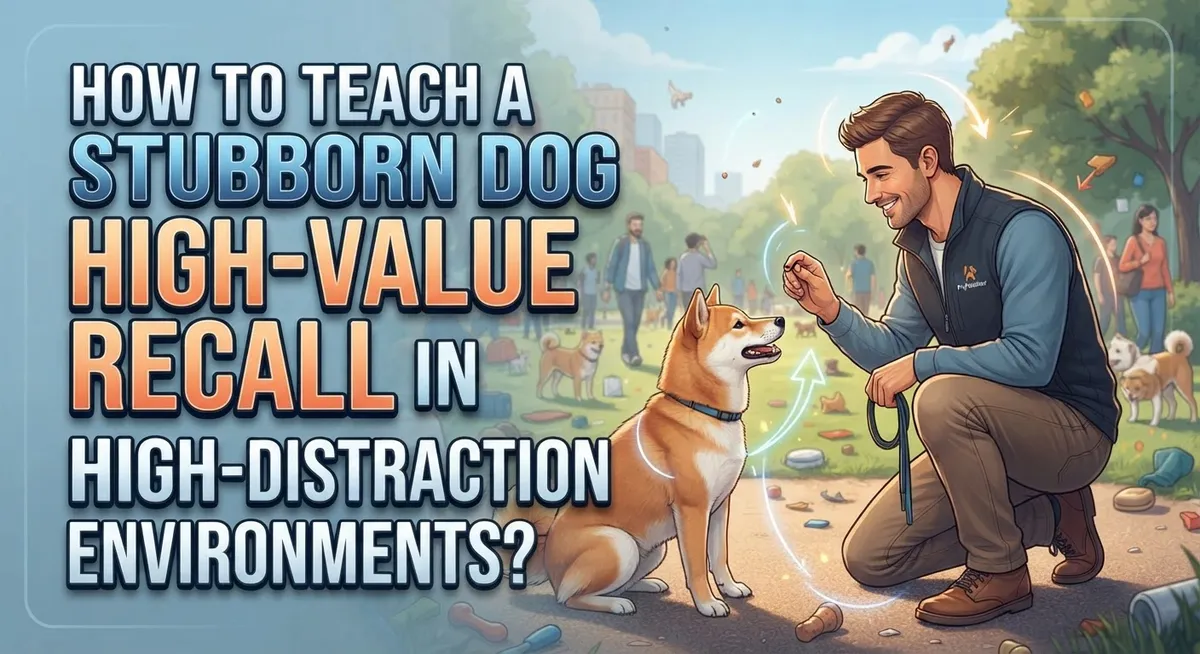
How to Teach a Stubborn Dog High-Value Recall in High-Distraction Environments?
Does your dog sprint the other way when you call them at the park? You are not alone.
Stubborn dogs often ignore recall when the world gets exciting. Squirrels, other dogs, and new smells feel more rewarding than your voice.
But here is the good news. Your dog is not broken and training is not hopeless.
This guide walks you through building rock-solid recall step by step. You will learn how to start training in a quiet space. Then you will see how to slowly add distractions without losing progress.
In a Nutshell
- Start small. Practice recall in a quiet room or backyard first. Master the basics before adding chaos.
- Rewards must be irresistible. Use high-value treats your dog rarely gets. Think chicken, cheese, or a favorite toy.
- Pick one cue and stick to it. Say “come” or “here” every single time. Never mix words or your dog gets confused.
- Keep the leash on. During distraction training, a leash gives you control. It stops your dog from practicing bad habits.
- Level up slowly. Once your dog nails recall indoors, try the backyard. Then a quiet park. Then busier spots.
- Match rewards to difficulty. A noisy dog park needs bigger rewards than your living room. Higher distraction means higher value treats.
Why Stubborn Dogs Struggle with Recall
Stubborn dogs struggle with recall for one simple reason: their brain prioritizes what they find more rewarding than you. When your dog sees a squirrel, another dog, or food on the ground, their instinct kicks into overdrive. Your voice becomes background noise.
These dogs aren’t being difficult on purpose. They are following their natural drives. A dog’s brain works on a reward hierarchy. If sniffing that tree or chasing that bird feels more exciting than anything you offer, they will choose the tree or bird every single time.
Distraction literally hijacks their focus. A stubborn dog’s attention span shrinks dramatically in stimulating environments. Their senses flood with new smells, sounds, and movement. Your recall command gets lost in the chaos. This is especially true for breeds bred to hunt or chase. Their genetics work against you in high-distraction settings.
Low-value rewards make things worse. A regular treat from your pocket cannot compete with real-world excitement. Your dog makes a quick mental calculation: “Is this treat worth giving up that amazing smell?” Most of the time, the answer is no.
Inconsistent training also confuses stubborn dogs. If you sometimes call them and sometimes don’t, or if different family members use different words, your dog learns that recall is optional. They test boundaries constantly.
The key is understanding your dog is not ignoring you out of spite. They are simply choosing what feels more rewarding in that moment. This is why high-value rewards and gradual progression work so well. You make coming back more exciting than anything else in their environment. You rebuild their reward hierarchy from the ground up.
Choosing High-Value Rewards That Actually Motivate
Your dog’s brain works like a reward calculator. When you call “come,” your stubborn pup weighs the value of the reward you’re offering against whatever they’re doing right now. If a squirrel or another dog seems more fun than your treat, they will ignore you every time.
High-value rewards are treats or toys your dog rarely gets. Most owners use everyday kibble or cheap treats during recall training. Your stubborn dog sees these as boring background noise. You need something that makes their eyes light up and their tail wag hard.
Think about what truly excites your dog. Some dogs go crazy for small pieces of chicken, cheese, or hot dog. Others prefer special freeze dried meat treats. A few stubborn dogs respond better to toys like balls or tug ropes than food rewards. Pay attention to what your dog chooses when given options.
The reward must match the distraction level. Training indoors? A regular treat works fine. At a busy park with other dogs? You need something extraordinary. This is the critical mistake most owners make. They use the same reward everywhere and wonder why their dog ignores them outside.
Rotate your high-value rewards too. If your dog eats chicken every single day, it becomes normal and loses its power. Keep rewards special and slightly unpredictable. Your dog should think “something amazing might happen if I come back.”
Test your rewards before training sessions. Offer the treat to your dog when they’re calm. If they eat it quickly and look for more, you have found a winner. If they sniff it and walk away, that reward is not high-value enough for your stubborn dog.
Building a Reliable Recall Foundation in Low-Distraction Spaces
Your dog needs a solid foundation before facing real-world distractions. This means starting in spaces where your dog’s attention stays on you naturally.
Pick a quiet room inside your home. A living room, bedroom, or hallway works perfectly. Your dog should have zero reasons to look away. No other pets, no windows showing activity outside, no toys scattered around. This empty space becomes your training ground.
Keep these early sessions short. Five to ten minutes is enough. Your dog learns faster with brief, focused practice than long, boring sessions.
Start by getting your dog’s attention without the recall cue yet. Toss a high-value treat on the ground and let your dog eat it. Then immediately toss another treat farther away. Your dog begins connecting you with good things happening.
Next, say your chosen cue word once. Use “come” or “here” consistently. The moment your dog moves toward you, reward instantly. Timing matters here. Your dog must link the word to the action and the reward in quick succession.
Gradually increase distance over multiple sessions. Start three feet away, then five, then ten. Your dog learns the cue means moving toward you pays off every single time.
Practice this foundation work for two to three weeks minimum. Yes, weeks. Rushing this step creates problems later. Your dog needs to build automatic responses before any distraction enters the picture.
During these low-distraction sessions, your dog’s success rate should hit 90 percent or higher. If your dog fails frequently, you are moving too fast. Go back to shorter distances and easier conditions.
This boring, quiet practice becomes the bedrock everything else builds on.
Step-by-Step Method to Teach the Recall Cue
Start in a quiet space where your dog can focus entirely on you. Choose one room indoors with no other people, pets, or sounds competing for attention. This removes all the noise that makes stubborn dogs tune you out.
Pick your recall cue word and stick with it. Use “come” or “here”—whatever you choose, say it the exact same way every single time. Your dog’s brain learns patterns, so consistency matters more than you think.
Get down to your dog’s level and show them a high-value reward. Let them see it, smell it, and get excited about it. This builds anticipation before you even say the cue word.
Say your cue once in a cheerful, upbeat voice. Don’t repeat it. Repetition teaches your dog to ignore the first few calls. When your dog moves toward you, reward immediately with that treat or toy.
Gradually increase the distance between you and your dog over multiple training sessions. Start three feet apart, then five feet, then ten feet. Do this only after your dog succeeds at closer distances.
Keep each training session short, around five to ten minutes. Stubborn dogs lose focus fast, and short sessions prevent frustration on both sides.
Practice this foundation work consistently for at least two to three weeks. Your dog should succeed at least 90 percent of the time before you move to distracting environments.
Repeat this same routine daily. Dogs learn through repetition, and consistency builds confidence. Once your dog reliably comes to you in this boring, quiet space, they’re ready for the next challenge.
Gradually Introducing Distractions and Outdoor Environments
Your dog has mastered recall in your quiet living room. Now comes the real test: the outside world. This is where most training falls apart because distractions explode all at once.
Start small with your outdoor space. If you have a backyard, begin there. Your backyard has fewer distractions than a park, so it’s the perfect bridge between indoor training and chaos. Keep your dog on a long leash during these early sessions. This safety net lets you prevent mistakes while your dog learns.
Practice the same recall cue you used indoors. Your dog needs consistency. Say “come” the exact same way every single time. Use the same high-value reward too. Your dog’s brain connects the cue, the environment, and the reward together.
Start with just one or two minor distractions. Maybe a toy sits nearby, or a family member walks around. Your dog shouldn’t be overwhelmed. The goal is success, not testing their limits yet.
Gradually add more elements over several weeks. Introduce sounds. Have someone play music softly. Bring in a second person. Let your dog see another animal at a distance. Each new distraction gets added slowly, one at a time.
Watch your dog’s focus. If they ignore you, the distraction level jumped too fast. Step back to an easier version. Your dog learns through small wins, not big failures.
Keep sessions short and end on success. A five minute session where your dog responds perfectly beats a thirty minute session filled with ignored commands. Each success builds their confidence and your relationship.
Troubleshooting Common Recall Setbacks
Your dog stops responding to recall when squirrels run past or other dogs appear nearby. This happens because the distraction level jumped too quickly. Your pup simply cannot focus on you when excitement takes over.
The most common cause is mismatched reward value. You used cheese at home, but now you’re offering kibble outdoors. Your dog sees a bird and thinks, “That’s way more interesting than this boring treat.” Always match your reward strength to the distraction level in your environment.
Another frequent setback involves inconsistent cue words. If you say “come” sometimes and “here” other times, your dog gets confused. Dogs thrive on predictability. Pick one word and use it every single time, no matter where you train.
Keep the leash on during early distraction training. This prevents your dog from making the choice to ignore you. The leash becomes your safety net while your pup learns that recalls in busy places still mean amazing rewards. Gradually reduce leash dependency as success improves.
Your dog may also ignore recall when overstimulated. This means their arousal level is too high for learning. Step back to a less distracting location and rebuild from there. Progression should happen slowly, not in giant jumps.
Track your success rate carefully. If your dog responds correctly less than 80 percent of the time in a particular environment, you moved forward too fast. Return to the previous difficulty level and stay there longer. Patience beats rushing every single time.
Mistakes That Undermine Recall Training
Many dog owners accidentally sabotage their recall training without realizing it. Understanding these pitfalls helps you avoid wasting weeks of effort.
Using low-value rewards in high-distraction settings is the biggest mistake. Your dog might respond perfectly to a basic treat in your living room, but that same reward means nothing when a rabbit runs past. The distraction always wins. You need premium, smelly, irresistible rewards that your dog loves more than the environment around them. Save ordinary treats for regular obedience work, not recall in challenging situations.
Skipping the foundation phase entirely derails many training plans. Some owners jump straight to outdoor training because they think their dog “should already know this.” Your dog hasn’t built the neural pathways yet. Rushing past quiet-space practice means your dog never develops a solid understanding of what the cue means. This creates confusion later.
Switching cue words mid-training confuses your dog significantly. Using “come” one day and “here” the next fragments their learning. Pick one word and commit to it. Every family member must use the identical cue every single time.
Punishing your dog for not coming destroys recall entirely. If your dog finally arrives after ignoring you five times, then you scold them, they learn that coming to you brings punishment. They’ll avoid you even more next time.
Inconsistent reward timing also undermines progress. Your dog must receive the reward within seconds of responding. Delayed rewards confuse the connection between the behavior and the positive outcome.
These mistakes are fixable. Awareness helps you train smarter and faster.
Maintaining and Strengthening Recall Long-Term
Once your dog masters recall in distracting environments, your work isn’t finished. You must maintain and strengthen this skill consistently over time. Dogs forget commands when you stop practicing, so regular training sessions keep recall sharp.
Schedule recall practice at least three to four times per week, even after your dog responds reliably. Keep these sessions brief, around five minutes each. Short, frequent practice beats long, sporadic sessions every time.
Vary your training locations regularly. Practice recall in different parks, neighborhoods, and outdoor spaces. Your dog learns context quickly, so training only in one spot means recall may fail elsewhere. Switch between morning and evening sessions too. This teaches your dog that recall matters everywhere, not just in familiar places.
Rotate your high-value rewards to prevent boredom. Use different treats, toys, or play styles throughout the week. Your dog stays motivated when rewards feel fresh and exciting.
Surprise your dog with random recall practice. Call your dog during normal playtime, not just formal training sessions. When your dog responds, offer an especially great reward. This unpredictability keeps recall sharp because your dog never knows when a reward opportunity appears.
Test your dog’s recall occasionally in new high-distraction environments. If your dog hesitates or ignores you, return to easier settings temporarily. This isn’t failure—it’s information. It tells you exactly where your dog’s training needs reinforcement.
Watch your success rate monthly. If your dog responds correctly less than 90 percent of the time, increase practice frequency. Consistency prevents backsliding and keeps your dog’s recall rock solid for years ahead.
Final Thoughts
Teaching a stubborn dog to recall in high distraction environments takes patience. It does not happen overnight. Your dog needs time to build new habits.
Start small and build up slowly. Quiet rooms come first. Busy parks come later. This order matters more than most owners realize.
High value rewards make the difference. Low value treats fail when squirrels or other dogs steal your dog’s attention. Save the best rewards for the hardest moments.
Stay consistent with your cue word. Switching between “come” and “here” confuses your dog. Pick one word and stick with it forever.
Keep your leash on during early distraction work. This simple tool prevents failure. It stops your dog from practicing the wrong behavior.
Every dog learns at a different pace. Some dogs master recall in weeks. Others need months of steady practice.
Do not compare your dog to other dogs. Focus on your own progress instead. Small improvements add up over time.
Celebrate small wins along the way. Your dog responded once in a noisy park? That counts as real progress.
Stubborn dogs often become the most reliable dogs once trained properly. Their strong will works in your favor when channeled correctly.
Recall training builds trust between you and your dog. Your dog learns you always have something good waiting. This trust keeps them coming back.
Think of recall as a lifelong skill. Keep practicing even after success. Consistency now prevents problems later.
Your effort today creates a safer, happier dog tomorrow. Stay patient. Stay consistent. Your stubborn dog can learn this skill with the right approach.
Frequently Asked Questions
Why does my stubborn dog ignore me when other dogs are around?
Your dog isn’t being stubborn on purpose. When other dogs are present, their attention goes to the more exciting stimulus. This happens because you haven’t yet matched your reward value to that specific distraction level.
Start by practicing recall when one calm dog is nearby at a distance. Use your absolute best reward—something your dog loves more than anything else. Gradually move closer to other dogs as your dog succeeds. The key is matching reward value to distraction intensity.
Can I use the same treat for all training stages?
No. Low-value treats won’t work in high-distraction environments. Your dog will choose the squirrel or another dog over a boring biscuit every time.
Reserve your highest-value rewards exclusively for distraction training. Save regular treats for less challenging situations. This teaches your dog that recall in crazy environments pays off better than ignoring you.
What should I do if my dog lunges toward a distraction instead of coming?
Keep your leash on during early distraction work. This prevents your dog from making the wrong choice while you’re still building reliability.
When your dog lunges, gently redirect with the leash. Then immediately call your recall cue. Reward heavily when your dog turns toward you. This teaches your dog that coming to you is better than chasing the distraction.
How do I know when my dog is ready for harder environments?
Progress only when your dog responds correctly at least 80 percent of the time in your current environment. If success drops below that rate, you’ve moved too fast.
Go back to an easier setting and rebuild confidence. Then advance more slowly next time.