How to Prevent Fish From Jumping Out of a Rimless Tank?
Rimless tanks are stunning. They offer an unobstructed view of your underwater world that standard tanks simply cannot match. But that open top design comes with a serious risk. Fish can and do jump out. It happens more often than most beginners expect, and it happens to experienced fishkeepers too.
The good news? You do not have to choose between the beauty of a rimless tank and the safety of your fish. There are many practical solutions that can reduce or eliminate the risk of losing fish to jumping. Some of these methods are simple and free. Others require a small investment but provide near total protection.
This guide will walk you through every proven method to keep your fish safely inside your rimless tank. You will learn why fish jump, which species are the biggest flight risks, and how to create an environment where jumping is far less likely.
Key Takeaways
- Fish jump out of rimless tanks for specific reasons such as stress, poor water quality, aggression from tank mates, sudden changes in water chemistry, and natural instinct. Identifying and fixing the root cause is the most effective prevention strategy.
- Lowering the water level by 1 to 2 inches below the rim of your tank is one of the simplest and most effective ways to reduce jumping incidents. A topped off tank with water at the very edge gives fish the easiest path out.
- Floating plants create a natural barrier at the water surface that discourages most fish from jumping. Species like Salvinia, Amazon Frogbit, and Red Root Floaters provide cover and reduce stress at the same time.
- Mesh screen lids and clear acrylic covers offer physical protection without blocking light or ruining the clean look of your rimless tank. DIY options are affordable and easy to build.
- Choosing the right fish species for an open top tank is critical. Some fish like Hatchetfish, Killifish, and many Tetras are natural jumpers. Bottom dwellers and slower moving species are safer choices.
- Maintaining stable water parameters and avoiding large sudden water changes will keep your fish calm and reduce the urge to jump. New fish are most at risk during their first week in your tank.
Why Do Fish Jump Out of Rimless Tanks
Understanding why fish jump is the first step to preventing it. Fish do not jump out because they want to escape. They jump because something in their environment triggers an instinctive response. In the wild, jumping helps fish escape predators, move between bodies of water, or catch insects above the surface.
In an aquarium, fish have no idea that a glass wall separates them from the open air. Every jump is essentially an accident from their perspective. The most common trigger is stress. Poor water quality, high ammonia levels, incorrect pH, or sudden temperature changes can all push a fish to jump.
Aggression from tank mates is another major cause. If a fish is being chased or bullied, it may try to flee by launching itself out of the water. This is especially common in tanks with territorial species or overcrowded conditions.
Some fish are simply natural jumpers. Species like Hatchetfish have evolved to leap above the water surface to catch flying insects. This behavior does not stop just because they live in a glass box. Even well fed fish in perfect water conditions will jump if it is in their nature to do so.
Sudden environmental changes also play a role. Many experienced fishkeepers report more jumping incidents after large water changes. A 75% water change can alter the water chemistry enough to stress fish into jumping. New fish are especially vulnerable during their first few days in a tank as they adjust to unfamiliar conditions.
Which Fish Species Are Most Likely to Jump
Not all fish are equal flight risks. Some species are notorious jumpers while others almost never leave the water. Knowing which fish are prone to jumping will help you make smarter stocking choices for your rimless tank.
Hatchetfish top the list of known jumpers. These surface dwelling fish have powerful pectoral muscles designed for leaping out of the water. In the wild, they use this ability to escape predators and catch food. Keeping them in a lidless tank is extremely risky.
Killifish, Bettas, and many species of Tetras are also frequent jumpers. Rainbowfish are fast swimmers that can launch themselves several inches above the water surface. Any fish that spends most of its time near the top of the water column should be considered a flight risk.
Kuhli Loaches and Amano Shrimp deserve special mention. Kuhli Loaches are escape artists that will find any gap to slither through, especially at night. Amano Shrimp are climbers that can crawl right out of the tank along equipment or decorations.
On the safer side, Corydoras Catfish, most bottom dwellers, Neocaridina Shrimp, Chili Rasboras, and Guppies tend to stay in the water. These species are better choices for open top setups. However, no fish is 100% guaranteed to never jump. Even the calmest species can surprise you under the wrong conditions.
Arowanas and African Butterflyfish are powerful jumpers that should never be kept without a secure lid. These fish can leap several feet and will easily clear the rim of any tank.
Lower the Water Level in Your Tank
This is one of the easiest and most effective methods to prevent fish from jumping out. Keeping the water level 1 to 2 inches below the top of the glass adds a vertical barrier that most fish cannot clear.
When your tank is filled to the very brim, a fish only needs a small burst of energy to break the surface and sail over the edge. But adding even a single inch of distance above the waterline makes a significant difference. Most small to medium fish simply cannot jump that high.
Experienced rimless tank owners consistently report this as their primary strategy. One aquarist shared that after topping off a tank for a dinner party to make it look nicer, they lost six fish in a single night. Once they returned to keeping the water level lower, the jumping stopped almost entirely.
The trade off is that a lower water level means slightly less volume in your tank. This can matter in smaller tanks where every gallon counts for maintaining stable water parameters. It also affects the look of your aquascape since the visible glass above the waterline can be distracting.
For most rimless tank owners, keeping the water about 1.5 inches below the rim is the sweet spot. It provides enough clearance to stop most jumpers without significantly reducing water volume or hurting the visual appeal. This method works best in combination with other strategies like floating plants.
Use Floating Plants as a Natural Barrier
Floating plants are a popular and attractive solution for rimless tank owners who want to keep the open top look. A thick layer of floating plants at the water surface creates a visual and physical barrier that discourages fish from jumping.
The science behind this is simple. Fish are less likely to jump when they cannot see the open air above them. Floating plants block their view of the surface and create a sense of cover and security. Stressed fish feel safer with overhead cover, which reduces one of the primary triggers for jumping.
Some of the best floating plants for this purpose include Salvinia, Amazon Frogbit, Red Root Floaters, and Water Lettuce. These plants grow quickly and spread across the surface to create dense coverage. Duckweed also works but can be very difficult to control once established.
Floating plants provide additional benefits beyond jump prevention. They absorb excess nutrients like ammonia, nitrite, and nitrate from the water. This helps keep your water cleaner and your fish healthier. Their dangling roots also provide hiding spots for shy fish and fry.
However, floating plants are not a guaranteed solution. A determined or panicked fish can still push through a layer of plants and jump out. Some fishkeepers have reported that their fish simply jumped right through the floaters. Think of floating plants as a strong deterrent rather than an absolute barrier. They work best for fish that are mild jumpers rather than species with powerful jumping ability.
Install a Mesh Screen Lid
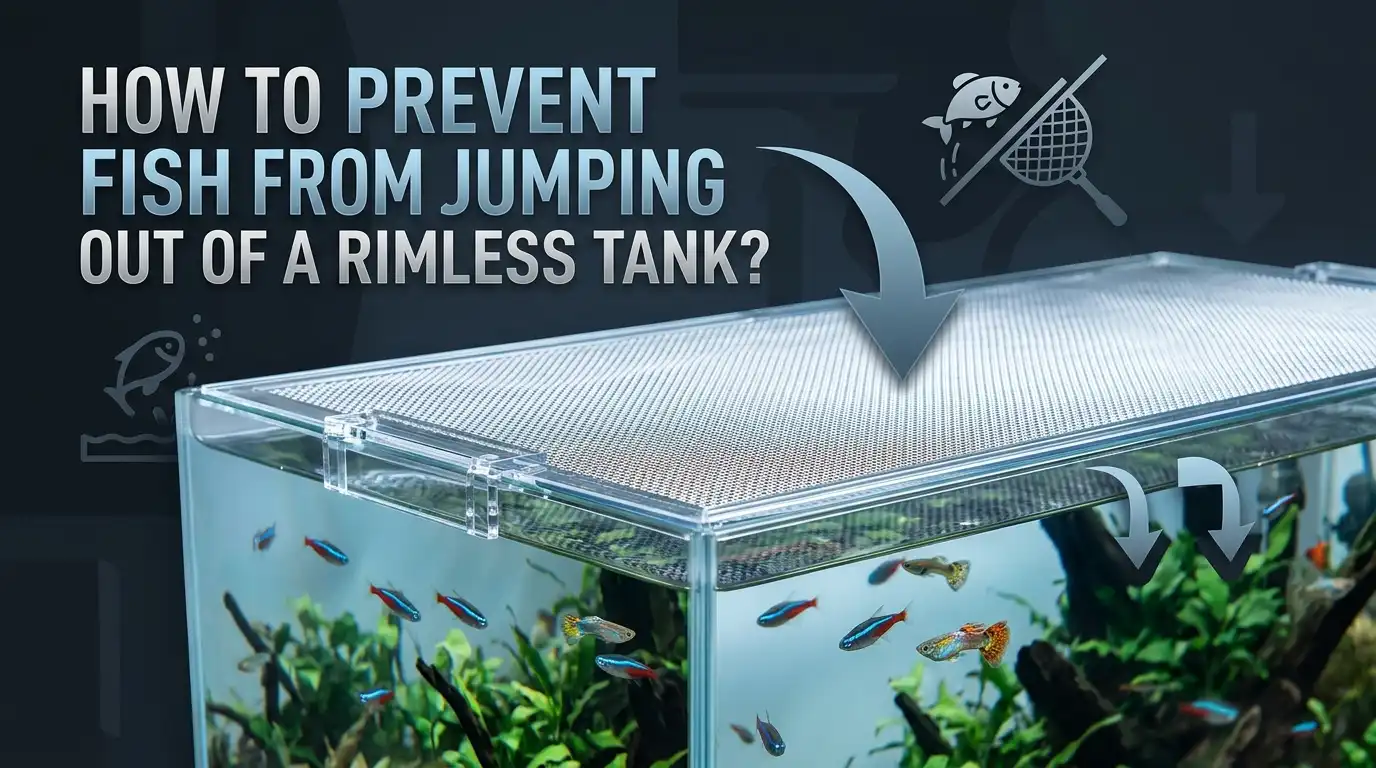
If you want near total protection without sacrificing the clean aesthetic of your rimless tank, a mesh screen lid is one of the best options available. These lids sit on top of your tank and prevent fish from escaping while allowing full light penetration and air exchange.
Mesh screen lids are made from fine netting or screen material stretched over a frame. The mesh is tight enough to stop even small fish from getting through but open enough to allow heat to escape and gas exchange to occur. This makes them ideal for planted tanks that need good airflow and lighting.
You can buy pre made mesh screen kits designed for rimless aquariums. These kits typically include a frame and clips that attach to the glass edges of your tank. Clear acrylic clips sit on the rim of the glass and hold the screen in place without any visible hardware.
The visual impact is minimal. From a normal viewing angle, a well made mesh screen is almost invisible. You maintain the open, modern look of your rimless tank while keeping your fish safe. Light passes through easily, so your aquarium plants will not suffer.
Mesh screens also prevent debris from falling into the tank and can keep curious pets like cats from getting to your fish. They are easy to remove for feeding and maintenance and can be cleaned with a quick rinse under the faucet.
Build a DIY Acrylic or Glass Lid
For fishkeepers who want a solid physical barrier, a custom acrylic or glass lid is a reliable solution. Since rimless tanks do not have a frame or ledge to support standard lids, you will need to use clip supports or build a custom frame.
Clear acrylic lid clips are available in sizes that match common glass thicknesses like 5mm, 6mm, 8mm, and 12mm. These small clips attach to the top edge of the glass and create a narrow ledge. A thin sheet of acrylic or glass then sits on these clips to cover the top of the tank.
Many rimless tank owners cut their own acrylic sheets to size. Acrylic is lightweight, easy to cut with basic tools, and shatter resistant. You can use a scoring tool or a fine tooth saw to cut it to your exact tank dimensions. Leave small gaps at the edges for filter hoses, heater cords, and air exchange.
Glass lids provide a more polished look and resist scratching better than acrylic. However, they are heavier and require more care during handling. You can order custom cut glass from a local glass shop at a reasonable cost.
A well designed lid should cover most of the surface while leaving space for equipment and airflow. Some fishkeepers create a split lid with two pieces that open from the center, similar to a book. This makes feeding and maintenance much easier while keeping the tank covered at all times.
Maintain Stable Water Parameters
Poor and unstable water quality is one of the top reasons fish jump out of tanks. Keeping your water parameters stable and within the correct range for your fish species will significantly reduce jumping behavior.
Ammonia and nitrite should always be at zero in a cycled tank. Even small spikes in ammonia can cause stress that triggers jumping. Test your water regularly, especially after adding new fish or making changes to your filtration.
Temperature stability matters too. A heater that fluctuates wildly or a sudden temperature shift during a water change can shock fish into erratic behavior. Match the temperature of your replacement water to your tank water before adding it.
Large water changes are a known trigger for jumping. Replacing 75% of the water at once can dramatically alter the pH, hardness, and chemistry of your tank. Stick to smaller, more frequent water changes of 20% to 30% at a time. If you must do a large water change, lower the water level temporarily and keep the lights dim to reduce stress.
CO2 levels in planted tanks also need careful management. A sudden increase in CO2 can drop the pH and cause fish to gasp at the surface, which increases the chance of a jump. Make CO2 adjustments gradually and monitor your fish for signs of distress after any changes.
Reduce Aggression and Overcrowding
A fish that is being bullied or chased will do anything to escape, including launching itself out of the water. Reducing aggression and providing adequate space for all your fish is essential for preventing jumping in rimless tanks.
Overcrowding creates stress for every fish in the tank. Fish compete for food, territory, and hiding spots. This competition leads to chasing, fin nipping, and constant harassment. The victims of this aggression are the ones most likely to end up on your floor.
Research the compatibility of every species before adding them to your tank. Mixing territorial fish with peaceful species is a recipe for problems. For example, keeping a male Betta with fast moving fin nippers like Tiger Barbs will almost certainly lead to stress and jumping.
Provide plenty of hiding spots and visual barriers within the tank. Rocks, driftwood, and dense plant groupings break up sight lines and give weaker fish places to retreat. When a fish has a safe hiding spot, it is far less likely to try escaping over the top.
Watch for changes in behavior after adding new fish. A peaceful tank can become aggressive overnight with the wrong addition. If you notice a fish being isolated or chased, consider rehoming the aggressor or rearranging the tank layout to break up established territories.
Be Extra Careful With New Fish
New fish are at the highest risk of jumping during their first week in your tank. The stress of being transported, acclimated, and placed in an unfamiliar environment makes new arrivals far more likely to attempt an escape.
When you add new fish, the water chemistry in your tank may differ from what they are used to. Even small differences in pH, hardness, or temperature can feel jarring to a fish. This discomfort can trigger erratic swimming and jumping.
Always lower the water level by an extra inch or two for at least a week after adding new fish. This simple step gives them a greater margin of error if they do attempt to jump. Combined with dimming the lights, it creates a calmer environment for the new arrivals.
Proper acclimation is critical. Use the drip acclimation method to slowly introduce your tank water to the fish over 30 to 60 minutes. This gradual process helps them adjust to the new water chemistry without shock.
Avoid making other changes during the first week of a new fish’s arrival. Do not rearrange the tank, do large water changes, or add other new fish. Let the new additions settle in peacefully. Once a fish has gone a week or two without jumping, the risk drops dramatically. Experienced aquarists report that fish that survive the first two weeks in an open top tank almost never jump later in life.
Use a Night Cover for Nocturnal Jumpers
Some fish are more active and more prone to jumping at night. If you notice fish losses happening overnight, a temporary night cover can solve the problem without permanently covering your tank.
Many fishkeepers report finding dead fish on the floor first thing in the morning. This pattern suggests that nighttime is the most dangerous period. Fish can be startled by shadows, lights from outside the room, or reflections on the glass after the tank lights go off.
Kuhli Loaches are a common example of nocturnal escape artists. They become very active after dark and can slither over the edge of a rimless tank with surprising ease. Other nocturnal species like Catfish and certain Plecos may also be more active after lights out.
A simple solution is to place a lightweight cover over the tank each night and remove it in the morning. This can be a mesh screen, a piece of acrylic, or even a clean sheet of egg crate lighting diffuser. The cover does not need to be fancy since it just needs to block escape routes for a few hours.
You can also reduce nighttime jumping by keeping a dim light on in the room. Complete darkness followed by a sudden light, such as someone turning on a hallway lamp, can startle fish into jumping. A low power night light near the tank provides just enough ambient light to prevent shock.
Choose a Taller Tank
The height of your tank plays a bigger role in jump prevention than most people realize. Taller tanks give fish more vertical space to swim, which means they are less likely to breach the surface.
In shallow tanks like a 33 gallon long or a 10 gallon standard, fish have limited vertical room. When startled, a quick burst of speed can easily carry them above the waterline. In a taller tank with 18 to 24 inches of water depth, fish have more space to redirect their energy downward or sideways.
Larger tanks in general seem to produce fewer jumping incidents. This makes sense because fish jump in all directions, not just toward the edges. In a tank with a large surface area, a jumping fish is statistically more likely to land back in the water rather than on the floor.
If you are still in the planning stage for your rimless tank, consider choosing a model with extra height. A cube style tank with equal length, width, and height provides a good balance of viewing area and jump prevention. The extra depth also benefits your aquascape and gives fish more room to establish territories.
Of course, a taller tank is not a solution by itself. Even in a deep tank, a determined jumper can clear the rim. But combined with other methods like a lower water level and floating plants, extra tank height provides one more layer of protection.
Avoid Placing Tanks Near Disturbances
Where you place your rimless tank can influence how often fish jump. Tanks located near high traffic areas, loud appliances, or windows with bright light changes can startle fish into jumping.
Vibrations from doors slamming, heavy footsteps, or speakers can travel through the floor and into the tank stand. Fish feel these vibrations and may react with a sudden burst of speed. In a rimless tank without a lid, that burst can carry them right over the edge.
Bright flashes from car headlights, lightning, or someone turning on a nearby lamp in a dark room are known to trigger jumping. Fish react to sudden changes in light intensity much more dramatically than humans do. If your tank is near a window that gets headlight sweeps at night, consider adding a curtain or moving the tank.
Keep the tank away from areas where children or pets frequently play. A curious cat batting at the water or a child tapping on the glass can frighten fish into panic mode. Even dogs running past the tank can create enough vibration and movement to startle fish.
Choose a calm, stable location for your rimless tank. A corner of a quiet room with consistent lighting is ideal. The fewer sudden environmental changes your fish experience, the calmer they will stay and the less likely they will be to jump.
Combine Multiple Prevention Methods
No single method is 100% effective at preventing fish from jumping out of a rimless tank. The most successful fishkeepers use a combination of strategies to minimize the risk as much as possible.
For example, you might lower the water level by one inch, add a thick layer of floating plants, and choose fish species that are not natural jumpers. This three layer approach addresses the problem from multiple angles. Even if one method fails, the others provide backup protection.
If you keep known jumpers like Tetras or Rainbowfish, adding a mesh screen lid on top of the other methods gives you the best possible protection. You can remove the lid during the day for maintenance and viewing, then replace it at night when most jumping occurs.
Pay attention to timing and triggers. Lower the water level further whenever you do water changes, add new fish, or adjust CO2 levels. These are high risk periods that call for extra caution. Once the tank has settled back to normal, you can return to your regular water level.
Track any jumping incidents and look for patterns. Did a fish jump right after a water change? During a thunderstorm? After you added a new species? Understanding the specific triggers in your tank will help you fine tune your prevention strategy. Over time, you will develop a routine that keeps your fish safe while maintaining the beautiful open top look of your rimless aquarium.
What to Do If You Find a Jumped Fish
Despite your best efforts, a fish may still end up on the floor. Acting quickly can save the fish’s life if you find it in time.
If the fish is still wet and you can see gill movement, place it back into the tank immediately. Handle it gently with wet hands to avoid damaging its slime coat. The slime coat protects the fish from infection, and losing it during a fall can lead to secondary health problems.
If the fish is not moving but is still moist, there may still be hope. Place it in a small container filled with tank water and observe it for several hours. Some fish can survive out of water for a surprising amount of time, especially species with a labyrinth organ like Bettas and Gouramis.
After returning a jumped fish to the tank, watch for signs of injury and infection over the next few days. Look for torn fins, missing scales, cloudy eyes, or white patches on the skin. You may need to treat the fish with a mild antibacterial or antifungal medication if you notice any of these symptoms.
If the fish is completely dried out and stiff, it is unfortunately too late. Use this experience as motivation to improve your jump prevention strategy. Evaluate what might have triggered the jump and add an extra layer of protection. Every loss is a learning opportunity that can help you protect the rest of your fish.
FAQs
Can floating plants alone stop fish from jumping out of a rimless tank?
Floating plants are a strong deterrent but not a guarantee. They create a visual barrier that makes most fish less likely to jump. Species like Salvinia and Amazon Frogbit work well for this purpose. However, a panicked or highly active fish can push through floating plants and still escape. Floating plants work best as part of a combined strategy that includes lowering the water level and choosing appropriate fish species.
What is the best lid option for a rimless aquarium?
A mesh screen lid offers the best balance of protection, airflow, and visual appeal. It stops fish from escaping while allowing full light penetration for plants and proper gas exchange. Clear acrylic or glass lids with clip supports are another excellent option that preserves the clean rimless look. The best choice depends on your specific tank dimensions, lighting setup, and personal preference.
How far should I lower the water level to prevent jumping?
Most experienced rimless tank owners recommend keeping the water 1 to 1.5 inches below the top of the glass during normal conditions. During high risk periods like water changes, adding new fish, or CO2 adjustments, lowering it to 2 inches provides extra safety. Going much lower than 2 inches can reduce your water volume too much and affect the visual appeal of the tank.
Do fish learn not to jump out of a rimless tank over time?
There is some anecdotal evidence that fish adapt to their environment over time. Many fishkeepers report that fish that do not jump during the first two weeks rarely jump later. Some hobbyists even use a temporary lid for the first week to “train” their fish. Once the fish learn the boundaries of their environment, they seem less likely to test them.
Are rimless tanks safe for Betta fish without a lid?
Bettas are known jumpers, so keeping one in a lidless rimless tank carries risk. However, many fishkeepers successfully keep Bettas in open top tanks by using a thick layer of floating plants and lowering the water level by at least 1.5 inches. A calm, well planted tank with stable water conditions reduces the Betta’s urge to jump. Still, a mesh screen lid is the safest option if you want complete peace of mind.
Which fish are safest for a rimless tank with no lid?
Bottom dwelling fish like Corydoras Catfish, Otocinclus, and Neocaridina Shrimp are among the safest choices. Chili Rasboras and Guppies are also relatively low risk. Avoid known jumpers like Hatchetfish, Killifish, Kuhli Loaches, and larger Tetras. Even with safer species, keeping the water level slightly lowered and adding floating plants is still recommended.